
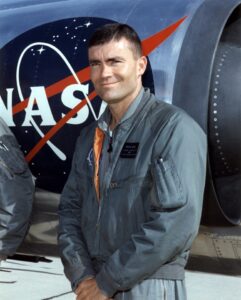
Fred Haise, Jr. (born November 14, 1933), a proud Biloxi, Mississippi native, is a former NASA astronaut, engineer, and military pilot whose career spanned research aviation, spaceflight, and aerospace leadership. He first began flying in the Naval Aviation Cadet Program before serving as a fighter pilot in both the U.S. Marine Corps and the Air National Guard. He proudly displays all three of his DD214’s from his three branches of service. He received an aeronautical engineering degree from the University of Oklahoma and applied to NACA (NASA’s predecessor agency). His experience qualified him to serve as a research pilot, during which he would eventually fly more than 80 airframes.
The first time Fred flew in an aircraft was as a Naval Aviation cadet in a Naval SNJ, an experience he later described as magical and one that sparked his lifelong interest in flying. He went on to join the Marines in order to get matched to a fighter airframe starting a trend of pursuing any opportunity to get higher and faster. Fred would go on to switch his commission to the Air National Guard to pursue a degree and continue flying before he would apply to NASA on the advice of his squadron commander.
As a research pilot for NASA, he was involved in a wide variety of experimental flight regimes. For Fred, the higher and faster the better. His early zero-G testing work in support of space exploration proved critical to the design of spacecraft for decades to come. Additionally, he flew investigative flights into the phenomenon of flutter for general aviation aircraft, leading to changes in the design and inspection of systems improving the safety of flight for all aviators. Upon the realization that he would not have the seniority to fly in the X-15, Fred decided to apply for the program promising the highest and fastest flight of the day: the Apollo program.
In April 1966 Fred was selected as part of NASA’s Astronaut Group 5 and began training for the Apollo program. He served as a backup for three missions: lunar module pilot for Apollo 8 and Apollo 11 and Commander for Apollo 16. On April 11, 1970 he launched on a Saturn V as the lunar module (LEM) pilot for Apollo 13, beginning the five-day epic story of ingenuity and survival that would become the most well-known days of his life. An in-flight explosion forced the crew to abort their lunar landing. Instead, Fred and his crewmates: Jim Lovell and Jack Swigert, became the test subjects in an ad hoc emergency plan that brought thousands of people together from around the world. No failure analysis accounted for an in-flight explosion where the crew survived, the move to the LEM required extensive communication and collaboration with ground control and technical experts to bring the crippled spacecraft safely back to Earth 5 days, 22 hours, 54 minutes, and 41 seconds after launch.
After Apollo, Fred moved to the Space Shuttle program, to continue pushing the next phase of space exploration. Using his previous test experience, he worked in the project office to influence the early design and training programs for the eventual shuttle system testing. Fred was named as a member in one of two crews involved in the approach and landing tests of the shuttle Enterprise in 1977, piloting the first free flight of the craft. He retired from NASA in 1979 to accept the Vice President of Space Programs position with Grumman, where he continued to work with space systems.
In his time with Grumman, Fred expanded his program experience within, but also beyond, aerospace. His programs included Space Shuttle wing manufacturing, Air Force missile-warning sensor development, and advanced satellite concepts. He also oversaw a number of service contracts in Space Shuttle turnaround operations, missile test support for the Navy, advanced flight training aircraft maintenance, as well as logistics, engineering, and deployment support for the Army. Fred even dabbled in postal service automation training, IRS document-scanning systems, and industrial equipment.
Following his retirement after 17 years with Grumman, Fred has kept busy inspiring the next generation to pursue science, aeronautics, and space exploration, hosting dozens of talks each year with schools and Civil Air Patrol. He is particularly proud of his work with the INFINITY Science Center, a non-profit science museum and the official visitor center for NASA’s Stennis Space Center, in his home state of Mississippi. He has been a passionate supporter, shaping the institution with his dedication to education and exploration.
