
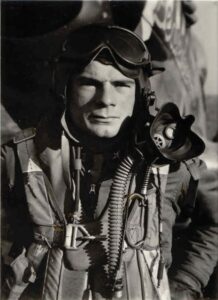
Colonel (Retired) Joseph Anthony Peterburs was born on 25 November 1924 in Saint Paul, Minnesota, and entered active duty on 30 November 1942 at just 18 years old as an Aviation Cadet. After completing extensive pilot training, he was assigned to the European Theater of Operations during World War II, flying P-51 Mustang fighters with the 20th Fighter Group, 55th Fighter Squadron of the Eighth Air Force based in England. Over the course of 49 combat missions, he destroyed five enemy aircraft on the ground and shot down one German Me-262 jet in aerial combat, while also attacking numerous ground and rail targets. During a strafing mission against a German airfield, his aircraft was severely damaged by enemy ground fire, forcing him to bail out at low altitude from his burning aircraft. He was immediately captured and interned as a prisoner of war, later escaping near Berlin and joining a Russian tank unit, with whom he fought from Berlin to the Battle of Wittenberg on the Elbe River until the end of the war.
Following World War II, Colonel Peterburs served in a variety of administrative and non-tactical leadership roles between August 1945 and December 1951. Most notably, he commanded an African American unit of more than 400 men during a pivotal period in U.S. military history. When the Armed Forces were officially desegregated in 1947, he was responsible for ensuring the smooth and effective integration of his unit, successfully navigating the transition with professionalism and leadership. That same year, he was promoted to the rank of Captain and transitioned into the Accounting and Finance career field, gaining experience that would later support his senior command and staff responsibilities.
In December 1951, Captain Peterburs was assigned to the 18th Fighter Bomber Wing, 12th Fighter Bomber Squadron, flying F-51D aircraft from Hoengsong, Korea. After only five hours of re-familiarization training in the aircraft, he began flying combat missions over North Korea. During this intense period, he flew 76 combat missions, sustaining battle damage on multiple occasions. On one mission, enemy ground fire penetrated the cockpit, causing multiple facial wounds and damage to his shoulder. Despite these injuries, he continued to serve in key leadership roles, including Squadron Flight Leader, Assistant Group Operations Officer, and Group Training Officer, demonstrating exceptional resilience and dedication under combat conditions. After returning from Korea, Major Peterburs was assigned to Tyndall Air Force Base, Florida, where he served as Operations Officer for a support unit flying F-51H, F-80A, F-80B, and T-33 aircraft. In 1954, he participated in atomic bomb testing at Camp Desert Rock, Nevada, observing a 20-kiloton nuclear detonation from a trench. In January 1955, he narrowly survived an emergency ejection from a burning T-33 aircraft due to a fire in the plenum chamber. From 1957 to 1960, he served in Newfoundland, Canada, as Chief Air Weapons Controller for the 64th NORAD Region Combat Operations Center. He then served as a Staff Operations Officer at NORAD Headquarters in Colorado Springs from 1960 to 1965, followed by an exchange assignment with the Royal Air Force Fighter Command at Bushy Heath, England, from 1965 to 1967. In October 1967, Lieutenant Colonel Peterburs was assigned to Seventh Air Force Headquarters at Tan Son Nhut Air Base in Saigon, South Vietnam, where he served as a Staff Operations Officer responsible for command and control of airspace over the war zone. During the Tet Offensive, a 122mm rocket struck directly adjacent to his living quarters, destroying his room while he slept—an event that underscored the constant danger faced even by personnel assigned to headquarters roles during the conflict. From 1968 to 1969, Colonel Peterburs served as Director of the 31st NORAD Region Combat Operations Center. Promoted to Colonel in 1969, he then assumed duties as Operations Officer for the 507th Tactical Air Control Group at Shaw Air Force Base, South Carolina, where he was primarily responsible for the introduction and integration of a new mobile, computerized Tactical Air Command and Control System into the Air Force inventory. From 1972 to 1978, he was assigned to Germany, serving as Air Liaison Officer to the U.S. Army Seventh Corps Commander, Commander of both the 601st and 600th Tactical Air Control Groups, and later as Deputy Commander for Tactical Control of the 601st Tactical Air Control Wing. During this period, he introduced advanced U.S. Air Force computerized mobile tactical command and control systems, developed command structures for more than 26 units, and successfully integrated these capabilities into NATO’s Central Region air defense architecture. Colonel Joseph Anthony Peterburs retired from active duty on 1 May 1979 after 36 years and 5 months of distinguished service.
