
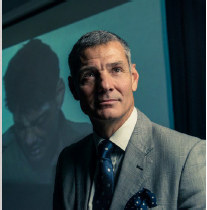
John Peters, Squadron Leader retired, RAF is a former Royal Air Force fighter pilot, combat veteran, author, and internationally respected authority on leadership, resilience, and performance under extreme pressure. He entered the world’s consciousness during the First Gulf War in January 1991, when images of his bruised and battered face—broadcast by the Iraqi regime after his capture—became an enduring symbol of the human cost of war. Shot down while flying a Tornado GR1 on the opening day of the conflict, John Peters endured 47 days as a prisoner of war, surviving systematic interrogation, physical abuse, and prolonged uncertainty that brought him repeatedly close to death.
John’s path to that defining moment began long before combat. Inspired by Britain’s aviation heritage and driven by an unshakable desire to fly, he earned his private pilot’s license at just 17 and was sponsored by the RAF through university as a cadet. After graduating from the University of Manchester, he progressed through jet training, flying the Jet Provost, Hawk, and ultimately the Tornado GR1. Though he describes himself as an “average fighter pilot,” his career reflected a deep professionalism, intellectual honesty, and an instinctive understanding of human performance. These qualities later defined his reputation as an exceptional instructor pilot and mentor to younger aircrew.
During the Gulf War, John and his navigator were assigned to a controversial daylight, low-level strike mission—one that would later be recognized as the final operation of its kind due to the evolving threat environment. Their aircraft was hit by a shoulder-launched missile during egress, forcing an ejection at low altitude over the Iraqi desert. Captured within hours, Peters was transferred to Baghdad, where he was subjected to intense physical and psychological abuse, including beatings, mock executions, sleep deprivation, and prolonged isolation. Throughout captivity, he adhered to a personal commitment formed early in his ordeal: regardless of what was done to him, he would not emerge as a “damaged human being.” That internal discipline—anchored in identity, values, and choice—became central to his survival.
Following his release, Peters returned to flying duties with the RAF, demonstrating a deliberate and uncompromising decision to continue serving only if he could fully commit to protecting those alongside him. He later rose to the rank of Squadron Leader and, within the Ministry of Defense, led programs focused on leadership, aviation safety, and human error—work that earned international recognition for innovation in training and organizational learning.
After leaving active service, John transitioned his wartime and military experience into a broader exploration of leadership at scale. He completed an MBA with distinction and founded an international consultancy, working with corporate, public-sector, and charitable organizations across Europe, the Middle East, Asia, and Africa. His work challenges conventional approaches to risk, failure, trust, and decision-making under uncertainty. As a speaker, he is known not for motivational rhetoric, but for intellectual rigor, moral clarity, and an unflinching examination of human behavior under pressure.
John Peters is the author of two best-selling books and the subject of the award-nominated documentary Tornado Down. He has addressed audiences ranging from frontline professionals to senior executives and heads of state, represented the British Armed Forces at national memorial services, and shared stages with global figures including Nelson Mandela. A Visiting Professor, experienced non-executive director, and trustee to several military and mental-health charities, he continues to contribute to conversations on service, responsibility, and resilience.
Married with two grown children, John Peters describes himself not as extraordinary, but as “a decent man who was given an extraordinary set of circumstances.” His life and work remain grounded in a simple but demanding belief: that character is revealed not by success or failure, but by the choices we make when control, comfort, and certainty are stripped away.
